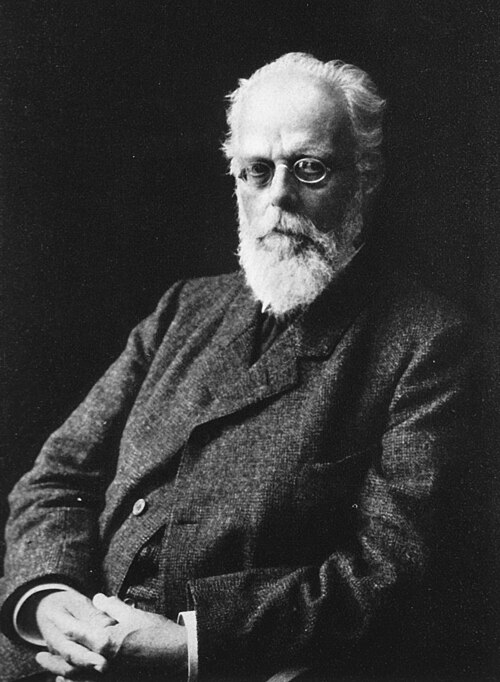

August Weismann
August Weismann proposed that the germline is distinct from the body (soma). He held that the hereditary material, the germ plasm, lies in the egg and sperm nuclei and passes between generations without being changed by the body12. Later authors kept the idea of a barrier, tested parts of his chromosome theory, and disputed his views on immortality and regeneration3456.
- Born
- 17 January 1834
- Died
- 5 November 1914
- Country
- Kingdom of Prussia
- Field
- zoologist, geneticist, physician
- In the library
- 1 work, named in 12 passages elsewhere
- Facts from
- Wikidata · Wikipedia · Open Library
Germ plasm and soma
Rádl reports that Weismann concluded that all the components of the adult body lie hidden in the egg and sperm nuclei. He named this nuclear protoplasm the germ plasm2. Solana describes the result as a continuous germline that gives rise to somatic cells but is not affected by them. This is the source of the later Weismann barrier1. Solana still finds the barrier useful for delineating the germline3.
Regeneration and experiment
Morgan took up Weismann's link between regeneration and liability to injury, which Weismann carried much further than other writers. Morgan examined it closely in his own book on regeneration6. Loeb cited Weismann among those who studied seasonal dimorphism in butterflies. Chilling summer pupae of Vanessa prorsa for several weeks gave specimens resembling the winter form7.
The concept that the germline is distinct from the soma was introduced in the late 19th century by August Weismann [1].
Solana J, 2013 · Closing the circle of germline and stem cells: the Primordial Stem Cell… · open at passage 5Thus Weismann came to the conclusion that all the components of the adult body lie hidden in the egg and sperm nuclei. He called the nuclear protoplasm which contained these components, the germ-plasm.
Rádl, E., 1930 · The History of Biological Theories · open at passage 644The old concept of a Weismann barrier is, therefore, useful in order to delineate the germline.
Solana J, 2013 · Closing the circle of germline and stem cells: the Primordial Stem Cell… · open at passage 14It has been demon- strated, in a manner which seems to be incontrovertible, that the reducing divisions postulated by Weismann actually occur, though not precisely in the manner conceived by him.
Wilson, E. B., 1896 · The Cell in Development and Inheritance · open at passage 578The fundamental distinction which Weismann makes between unicellular and multicellular organisms respecting immortality may be attacked from another side.
Verworn, M., 1899 · General Physiology: An Outline of the Science of Life · open at passage 879Weismann in his book on The Germ Plasni has adopted the principle of a connection between regeneration and liability to injury and has carried it much farther than other writers.
Morgan, T. H., 1901 · Regeneration · open at passage 235By keeping the pupae of Vanessa prorsa several weeks at a temperature of from o° to i° Weismann succeeded in obtaining from the summer chrysalids specimens which resembled the winter variety
Loeb, J., 1916 · The Organism as a Whole, from a Physicochemical Viewpoint · open at passage 465