Charles Scott Sherrington
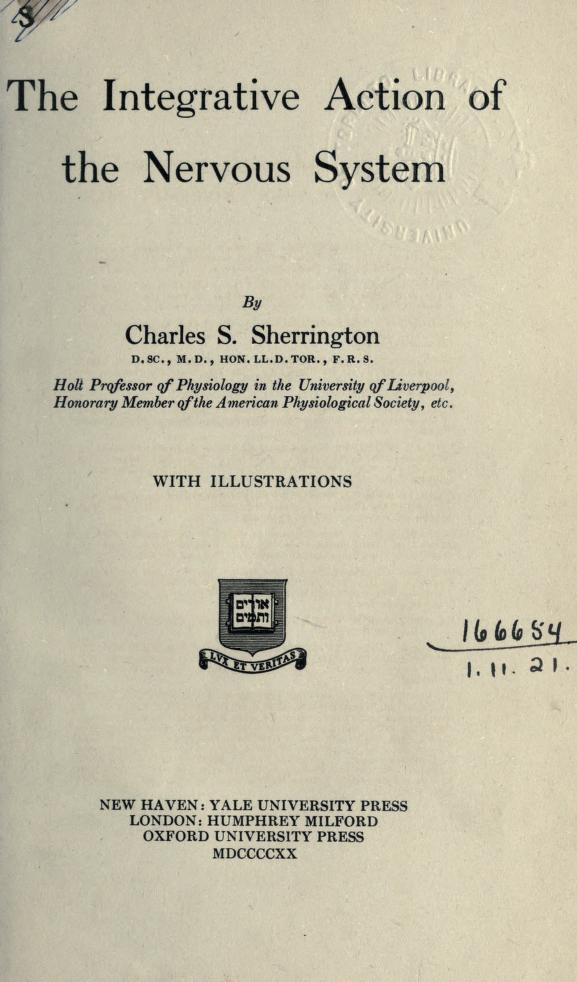
Sherrington studied reflex action in the spinal cord and lower brain. In The Integrative Action of the Nervous System, Sherrington named the displacement of one reflex by another "interference"1 and traced spinal shock to the loss of influence from above the cut2. Later authors used the spinal and decerebrate preparations that came from this work34.
- Born
- 27 November 1857
- Died
- 4 March 1952
- Country
- United Kingdom
- Field
- physician, neurologist, university teacher
- In the library
- 1 work, named in 12 passages elsewhere
- Facts from
- Wikidata · Wikipedia · Open Library
Reflexes and shock
In The Integrative Action of the Nervous System, Sherrington described how one reflex displaces another. The replacement may be inhibition after excitation, excitation after inhibition, or one kind of excitation after another. Steady tonic flexion can give way to the rhythmic flexion of the scratch reflex. Sherrington called all such cases interference1. The same work took up spinal shock. It held that shock came not from the irritation of the cut but from the cut removing some influence from above the spinal cord2.
Preparations and receptors
Bayliss credited Sherrington with showing that a spinal animal, cut off from higher centres and recovered from shock, can be kept alive and healthy. Most of the spinal reflex results Bayliss set out were attributed to the same work3. Bayliss also described the decerebrate cat, reported by Sherrington in 1898. It keeps the brain below the posterior colliculi and shows tonic rigidity of extensor muscles4. Washburn reported Sherrington's term "distance receptors" and the claim that they contribute most to the uprearing of the cerebrum5.
Use by later authors
Bose quoted a Sherrington experiment on heat pain. Heat from a lamp was focused on about 25 sq. mm. of skin on the back of the hand, and a perforated screen intercepted it at intervals6. Crile took up Sherrington's suggestion that the synapse might accumulate electric charges and support a double electric layer7. Child called the reflex Sherrington's unit reaction.
In all these cases the process of displacement of one reflex action by the other may be termed interference. We thus get a comprehensive convenient term for embracing the whole series of cases.
Sherrington, C. S., 1906 · The Integrative Action of the Nervous System · open at passage 416Shock referable not to the irritation of the trauma but to the cutting off by the trauma of some supra-spinal influence.
Sherrington, C. S., 1906 · The Integrative Action of the Nervous System · open at passage 12Such an animal is called by Sherrington the spinal animal, and it is by his work that the possibility of maintaining such animals alive and healthy has been demonstrated.
Bayliss, W. M., 1915 · Principles of General Physiology · open at passage 2109described by Sherrington (1898), for which a cat is best, retains all parts of the central nervous system below the posterior colliculi and shows tonic rigidity of extensor muscles.
Bayliss, W. M., 1915 · Principles of General Physiology · open at passage 2157“the distance receptors contribute most to the uprearing of the cerebrum.”
Washburn, M. F., 1908 · The Animal Mind: A Textbook of Comparative Psychology · open at passage 506I found that by focussing the heat rays from a lamp upon a skin area of about 25 sq. mm. (on the back of the hand), and allowing a perforated screen to intermittently intercept the radiation
Bose, J. C., 1907 · Comparative Electro-Physiology: A Physico-Physiological Study · open at passage 1514It might restrain diffusion, bank up. osmotic pressure, restrict the movement of ions, accumulate electric charges, support a double electric layer
Crile, G. W., 1926 · A Bipolar Theory of Living Processes · open at passage 176The reflex is the unit reaction (Sherrington) or the physiological unit (Parker) on which nervous function and integration are built up
Child, C. M., 1924 · Physiological Foundations of Behavior · open at passage 604