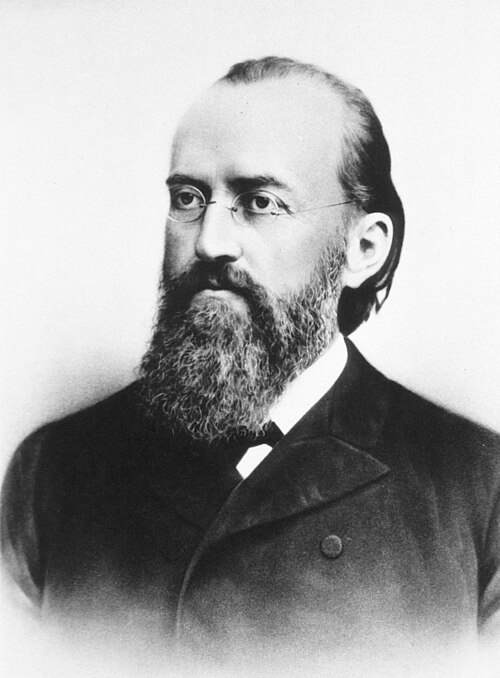

Ewald Hering
Hering also held that the electric phenomena of nerve and muscle arise from changes in chemical function5.
- Born
- 5 August 1834
- Died
- 26 January 1918
- Country
- Kingdom of Saxony
- Field
- physiologist, pedagogue, university teacher
- In the library
- 1 work, named in 6 passages elsewhere
- Facts from
- Wikidata · Wikipedia · Open Library
Memory and organised matter
Rádl dates Hering's analogy between bodily and mental development to 1870 and says Butler later took the same idea for a new discovery1. Rádl says Hering saw it as a plain deduction from Fechner's view that psychical and material life are parallel aspects of one event2. Rádl is critical. He says the theory stirred debate in the seventies but added nothing new. He describes it as making life a passive repetition of what was acquired3, and imagination a sum of memories4. For Rádl it ignored the organism's own form.
Electricity and chemical function
Child lists Hering among physiologists who stressed living factors over purely physical accounts of excitation. Hering argued that the electric phenomena of nerve and muscle follow from changes in chemical function5. Child adds that Biedermann, a pupil of Hering, took up this view and that it was called the Hermann-Hering theory6. Lillie writes that Hering reached general ideas on how the current relates to protoplasmic action before modern physical chemistry existed7.
Vision and space
James discusses Hering in his treatment of visual space. James sets this against Stumpf, who looked for an immediate physical basis of distance. James also cites Hering for the remark that skill in discriminating double images cannot be mastered in a year or two.
Before Butler, Ewald Hering, the physiologist, had pointed out an analogy between the development of body and of soul (1870).
Rádl, E., 1930 · The History of Biological Theories · open at passage 714Hering regarded it as a pure deduction from Fechner's theory, which affirms that our psychical and our material lives are two parallel aspects of one event.
Rádl, E., 1930 · The History of Biological Theories · open at passage 714According to Hering's view, life consists merely of the passive repetition of all that has been learned, all that has been acquired.
Rádl, E., 1930 · The History of Biological Theories · open at passage 716It teaches that imagination is but the sum of all memories, the organism merely the sum of all acquired characters.
Rádl, E., 1930 · The History of Biological Theories · open at passage 716Hering (’79, ’88) also maintained that the electric phenomena of nerve and muscle result from changes in chemical function.
Child, C. M., 1924 · Physiological Foundations of Behavior · open at passage 455Biedermann (’96), a pupil of Hering, adopted essentially this viewpoint and called it the Hermann-Hering theory.
Child, C. M., 1924 · Physiological Foundations of Behavior · open at passage 455Many years ago, before the development of modern physical chemistry, Hering reached certain general conceptions of the relation of the current to protoplasmic action
Lillie, R. S., 1923 · Protoplasmic Action and Nervous Action · open at passage 667But what constitutes the localization of the Kernpunkt itself at any given time, except ' Experience,' i.e., higher cerebral and intellectual processes, involving memory, Hering does not seek to define.
James, W., 1890 · The Principles of Psychology, Vols. 1-2 · open at passage 2192