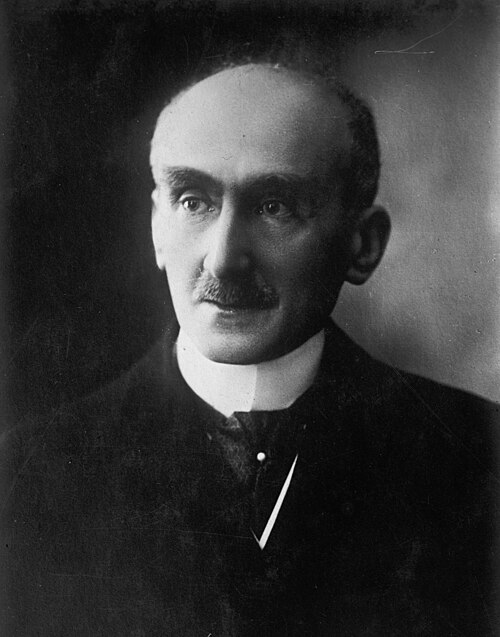
Henri Bergson
Bergson was a philosopher whose Creative Evolution put an élan vital in place of both mechanism and strict finalism. Driesch also praised Bergson's earlier work on memory and action1.
- Born
- 18 October 1859
- Died
- 4 January 1941
- Country
- France
- Field
- philosopher, professor, sociologist
- In the library
- 1 work, named in 11 passages elsewhere
- Facts from
- Wikidata · Wikipedia · Open Library
Critique of Darwinian history
Rádl reports that Bergson argued against Darwinian theories on one point. They did not describe what actually happened. They showed a series of forms, like frames of a film, that could be pictured as all existing together5. For Bergson, evolution was a continual process of change, driven by an impetus present since life began. Rádl judges that the theory did not directly shape evolutionary biology, but added to growing doubt about Darwinian ideas6.
Use by Thompson and Driesch
Thompson borrowed Bergson's phrase "ideal kinship" for the relation of likeness between forms. Driesch, separately, credited Bergson's work on memory with establishing an autonomy of acting, in parallel with his own argument1.
had, as early as 1896, established what I should call the autonomy of acting, by a discussion which, though confined to Psychology, and therefore different
Driesch, H., 1908 · The Science and Philosophy of the Organism · open at passage 158Bergson only analyses phylogeny ; in ontogeny le tout est donne — and yet there is "vitalism.
Driesch, H., 1908 · The Science and Philosophy of the Organism · open at passage 633Bergson's hypothesis is, however, in es- sence not less vitalistic than that of Driesch.
Henderson, L. J., 1913 · The Fitness of the Environment · open at passage 428there is no reason so far to believe that Driesch’s entelechy or Bergson’s élan vital is any more necessary for such creation than for the creation of a new chemical compound
Child, C. M., 1924 · Physiological Foundations of Behavior · open at passage 621Bergson proves, however, that Darwinian theories do not really represent an effort to discover the history of events, to describe what actually happened.
Rádl, E., 1930 · The History of Biological Theories · open at passage 927Bergson's theory did not directly influence evolutionary theories. But indirectly it was of considerable importance
Rádl, E., 1930 · The History of Biological Theories · open at passage 927what Bergson calls* the “ideal kinship” is plain and certain, but the “material affiliation” is problematic and obscure
Thompson, D. A. W., 1992 · On Growth and Form · open at passage 1328

