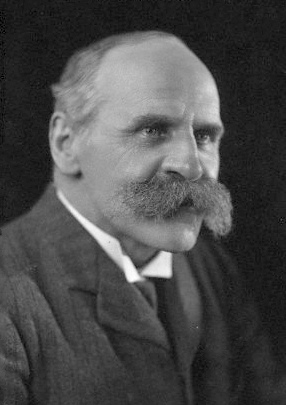
John Scott Haldane
Haldane studied breathing and blood gases and used the results to argue that an organism is a co-ordinated whole. He asked how such co-ordinated maintenance arises in living things but not in the inorganic world1. With colleagues he measured how breathing is regulated by alveolar carbon dioxide2 and how haemoglobin takes up carbon monoxide5.
- Born
- 3 May 1860
- Died
- 15 March 1936
- Country
- United Kingdom
- Field
- inventor, physiologist, philosopher
- In the library
- 1 work, named in 9 passages elsewhere
- Facts from
- Wikidata · Wikipedia · Open Library
Regulation of breathing
In his 1917 lectures Haldane described work on breathing air very short of oxygen. The alveolar carbon dioxide pressure still regulated the breathing, but it was set at a lower level2. The early panting reflected the large reserve of carbon dioxide in the blood and lymph. When oxygen fell only gradually, no evident panting appeared, though breathing still increased3. He also pointed to the kidney. Sodium chloride vanishes from the urine once its blood concentration falls below normal4.
Carbon monoxide and haemoglobin
Bayliss cited Douglas, Haldane and Haldane (1912) for the finding that the relative affinity of haemoglobin for oxygen and carbon monoxide differs between individuals. They placed the cause in the globin, since the haematin part is always the same. Bayliss found it hard to square this with iron alone binding the gases5. He also reported Hartridge's refinement of the Douglas and Haldane carbon monoxide method, using the shift of absorption bands6. Hartridge found no oxygen secretion by the lungs. Douglas and Haldane held that it could not be detected until acclimatisation had developed7.
Organism as a whole
Haldane argued that the reactions of an organism, both internal and with its environment, are co-ordinated so that its life maintains itself. He said ordinary inorganic observation shows nothing like this1. Lillie later cited Haldane's 1908 British Association address, which called nutrition a constant process of reproduction and heredity an axiom for biology. Lillie held that these remarks did not dispose of the problem of heredity8.
In the inorganic world as ordinarily observed and inter- preted we find no such co-ordinated maintenance.
Haldane, J. S., 1917 · Organism and Environment as Illustrated by the Physiology of Breathing · open at passage 12On studying more closely the effects of breathing air very deficient in oxygen we found that the alveolar CO2 pressure still regulates the breathing; but the regulation is, as it were, set at a lower level.
Haldane, J. S., 1917 · Organism and Environment as Illustrated by the Physiology of Breathing · open at passage 78If the oxygen percentage or pres- sure in the air is only diminished gradually there is no evident panting, although there is still some increase in the breathing
Haldane, J. S., 1917 · Organism and Environment as Illustrated by the Physiology of Breathing · open at passage 78If, for instance, the concentration of sodium chloride in the blood falls below normal, sodium chloride disappears at once from the urine, though it is still abundant in the blood.
Haldane, J. S., 1917 · Organism and Environment as Illustrated by the Physiology of Breathing · open at passage 118Douglas, Haldane, and Haldane (1912) point out that the relative affinity of haemoglobin for oxygen and carbon monoxide varies in different individuals.
Bayliss, W. M., 1915 · Principles of General Physiology · open at passage 2642Hartridge (1912, I) introduced an improvement in the carbon monoxide method of Douglas and Haldane, by substituting observation of the change of position of the absorption bands
Bayliss, W. M., 1915 · Principles of General Physiology · open at passage 2702Douglas and Haldane now hold that it is not to be detected until acclimatisation has been developed.
Bayliss, W. M., 1915 · Principles of General Physiology · open at passage 2702nutrition itself is only a constant process of reproduction" and "heredity is for biology an axiom and not a problem,
Lillie, R. S., 1923 · Protoplasmic Action and Nervous Action · open at passage 18