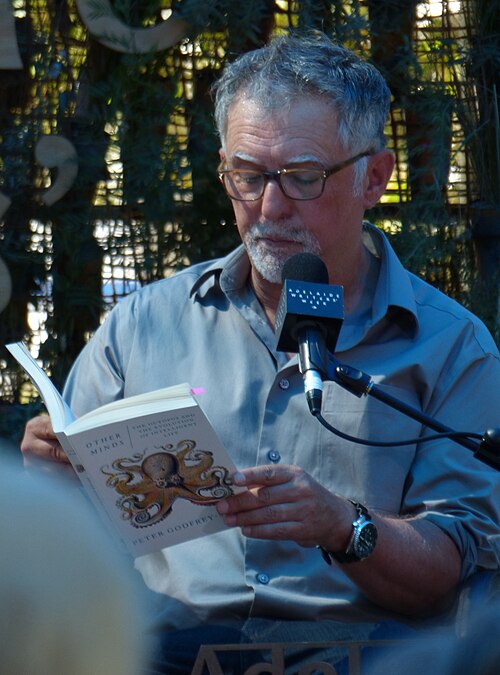
Peter Godfrey-Smith
Godfrey-Smith put forward the environmental complexity thesis in 1996: the function of cognition is to deal with environmental complexity3. Later authors took it up as an account of why cognition grows more powerful in some lineages1, applied it to bacteria2, and tested it against early nervous systems4.
- Born
- 1 January 1965
- Country
- United States
- Field
- philosopher, university teacher
- In the library
- 1 work, named in 12 passages elsewhere
- Facts from
- Wikidata · Wikipedia · Open Library
Environmental complexity thesis
Lyon describes the thesis as an evolutionary ratchet: the complexity of the ecological niche drives cognition toward more complex and powerful forms in some lineages1. Lyon adds that Godfrey-Smith did not have microbes in mind, yet bacteria may be the best test case of the thesis. Lyon also borrows the phrase 'basic toolkit' from the 1996 work for capacities that bacteria share with complex animals2. Keijzer and Arnellos call the thesis influential and read it as an externalist proposal that puts environmental heterogeneity first3.
Internal coordination and nervous systems
Keijzer and Arnellos note that Godfrey-Smith's later work, with Jékely and colleagues, separates two views of early nervous systems: internal coordination and input-output4. The input-output view fits the environmental complexity thesis most easily. Keijzer and Arnellos press the claim that internal coordination explains the transition to the modern animal body, and they use this as a challenge to the thesis4.
Individuality, agency and primitiveness
Watson and colleagues use it for the idea that the evolutionary unit sits at the level where variation in reproductive success is heritable5. Levin cites it for a gradualist view of individuality and for an agential perspective that looks different at different scales of observation6. Fábregas-Tejeda and Sims cite a 2017 work for the point that 'simple' does not always mean evolutionarily primitive, which they offer as a caution for basal cognition research7.
Godfrey-Smith (1996) advanced the idea that the evolutionary ratchet driving cognition to more complex and powerful forms in some biological lineages is the complexity of the ecological niche they inhabit.
Lyon P, 2015 · The cognitive cell: bacterial behavior reconsidered · open at passage 49bacteria also appear to possess a ‘basic toolkit’ (Godfrey-Smith, 1996), which in other forms of life—especially mammalian life – would be termed cognitive.
Lyon P, 2015 · The cognitive cell: bacterial behavior reconsidered · open at passage 17The function of cognition is to enable the agent to deal with environmental complexity.
Keijzer F, Arnellos A, 2017 · The animal sensorimotor organization: a challenge for the environmental… · open at passage 2Godfrey-Smith’s own recent work (Godfrey-Smith, in press; Jékely et al. 2015a), which recognizes a distinction between Internal Coordination (IC) and Input–Output (IO) views
Keijzer F, Arnellos A, 2017 · The animal sensorimotor organization: a challenge for the environmental… · open at passage 7the evolutionary unit can be defined by the level (or levels) of organisation where variation in reproductive success is heritable (evo ← ego) (Clarke 2010; Godfrey-Smith 2009)
Watson RA, Mills R, Buckley CL, Kouvaris K, Jackson A…, 2016 · Evolutionary Connectionism: Algorithmic Principles Underlying the Evolution of… · open at passage 10The agential perspective (Godfrey-Smith, 2009) looks different at different scales of observation
Levin M, 2022 · Technological Approach to Mind Everywhere: An Experimentally-Grounded Framework… · open at passage 53‘simple’ does not always mean evolutionarily primitive (see also Godfrey-Smith, 2017)
Fábregas-Tejeda A, Sims M, 2025 · On the prospects of basal cognition research becoming fully evolutionary… · open at passage 53what nervous systems do is achieve specific kinds of cell–cell interaction—interactions that are fast, targeted, and directional
Pecere P, 2026 · Plant cognition after Darwin: historical and epistemological remarks · open at passage 58

