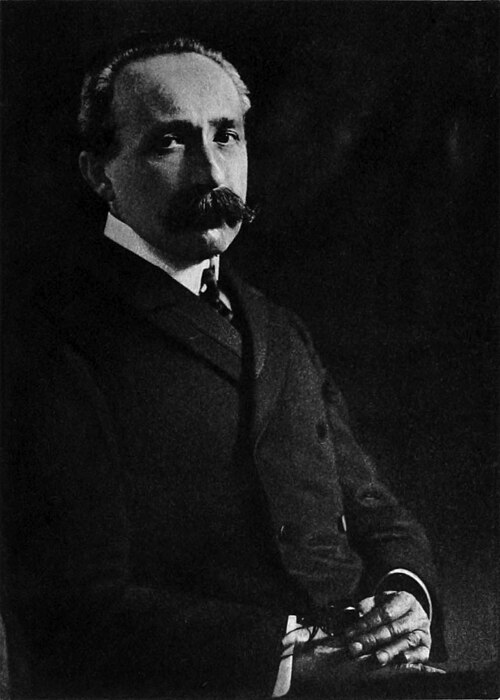
- Born
- 22 August 1859
- Died
- 27 December 1918
- Country
- German Empire
- Field
- zoologist, evolutionary biologist, university teacher
- In the library
- 1 work, named in 8 passages elsewhere
- Facts from
- Wikidata · Wikipedia · Open Library
Memory as heredity
Child traced the notion that heredity resembles memory to Hering's earlier paper on memory as a general function of organized substance. Semon then developed it in great detail, but in Lamarckian terms1. Child added that the mnemic view of heredity need not be Lamarckian. Rádl described Semon's work as an extension of Hering's theory into an hypothesis about evolution3.
Terms and their reception
Rádl said Semon tried to save Darwinism by giving it a psychological interpretation. Mneme stood for the sum of characteristics acquired by the organism and its ancestors, and engram for one material change resulting from a stimulus34. Rádl objected that the new names did not aid the discussion. Rádl also noted that the work was favourably received in Darwinian quarters4. Driesch borrowed the name from Semon's book when describing the brain as a store of impressions5.
The engram in later work
Baluška and Levin quoted Semon for the view that memory requires stimuli to leave a permanent record in irritable substance, and asked what non-neural mechanisms could hold such records6. Bédécarrats and colleagues called identifying the engram, the physical memory trace, a major goal of modern neuroscience.
Later Semon (04 and later works) developed the idea in great detail, but in Lamarckian terms.
Child, C. M., 1924 · Physiological Foundations of Behavior · open at passage 645Manifestly this mnemic conception of heredity is not necessarily Lamarckian. Even if heredity is protoplasmic memory, it is not necessarily memory of
Child, C. M., 1924 · Physiological Foundations of Behavior · open at passage 645This step was taken by Semon (1906), who endeavoured to save Darwinism by giving to it a psychological interpretation.
Rádl, E., 1930 · The History of Biological Theories · open at passage 717Mneme which is the title of his work is to represent the sum of all those characteristics acquired by the organism and its ancestors; engramm, a single material change resulting from a stimulus.
Rádl, E., 1930 · The History of Biological Theories · open at passage 717Borrowing a very convenient name from a book of Semon's,2 we may say that th
Driesch, H., 1908 · The Science and Philosophy of the Organism · open at passage 206Memory, and often the intermediate processes of computation, requires that “stimuli produce a permanent record written on the irritable substance” (Semon and Simon, 1921).
Baluška F, Levin M, 2016 · On Having No Head: Cognition throughout Biological Systems · open at passage 11A major goal of modern neuroscience is to determine the identity of the engram, the physical memory trace (Semon, 1921).
Bédécarrats A, Chen S, Pearce K, Cai D, Glanzman DL, 2018 · RNA from Trained Aplysia Can Induce an Epigenetic Engram for Long-Term… · open at passage 1

