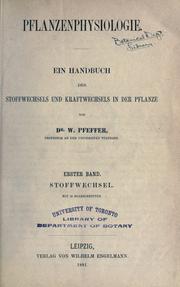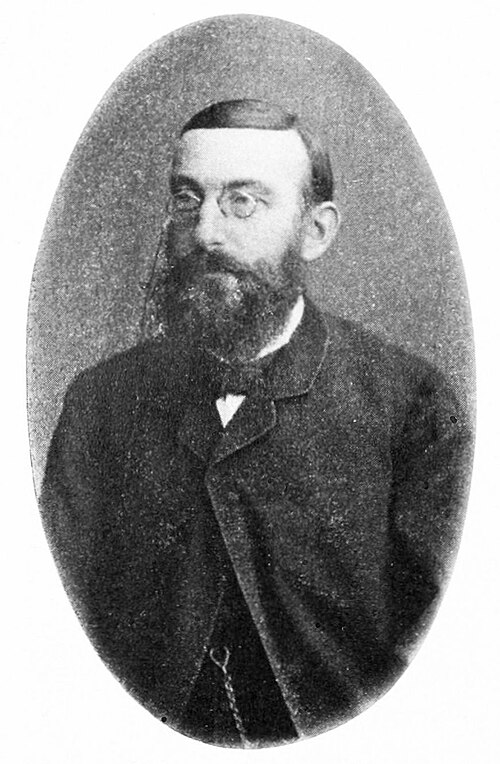
Wilhelm Pfeffer
Pfeffer was a plant physiologist whose experiments later authors used in several fields. He showed that chemical substances attract the swimming spermatozoids of ferns12. His work on how a stimulus travels through Mimosa was taken as evidence for a non-nervous, hydro-mechanical mode of conduction, and Bose disputed that reading45.
- Born
- 9 March 1845
- Died
- 31 January 1920
- Country
- Kingdom of Prussia
- Field
- botanist, pharmacist, university teacher
- In the library
- 1 work, named in 12 passages elsewhere
- Facts from
- Wikidata · Wikipedia · Open Library
Chemotaxis of fern spermatozoids
Verworn described the method. A sealed capillary tube of dilute malic acid was placed in a drop of fern spermatozoids, and the acid diffused out as a one-sided stimulus2. Verworn reported that the cells steered into the tube in large numbers. Loeb called this the experiment that began the study of sperm attraction toward the egg3.
Conduction in Mimosa disputed
In Pfeffer's case a strong stimulus crossed a chloroformed part of the petiole4. Pfeffer took chloroform to have abolished conductivity there5. Bose rejected this inference. He also noted that Pfeffer and Haberlandt disagreed on the channel. Pfeffer named the wood vessels, while Haberlandt named tubular cells of the phloem6.
Membranes and the nucleus
Bayliss cited Pfeffer when discussing Nägeli's experiment. Protoplasm squeezed from a crushed root hair forms a membrane on its free surface7. Crile drew on Pfeffer's moss protonema work. Anucleate protoplasm joined by thin filaments to a nucleated cell formed a membrane. The greatest distance Pfeffer observed was 3.7 mm8. Crile used this in support of his own theory of the nucleus.
M. Pfeffer discovered that certain chemical substances have the property of attracting these spermatozoids.
Binet, A., 1888 · The Psychic Life of Micro-organisms: A Study in Experimental Psychology · open at passage 196He filled a capillary tube, sealed at one end, with a solution of c. 0'05 per cent, malic acid and placed it in a drop that contained a great number of the spermatozoids of a fern
Verworn, M., 1899 · General Physiology: An Outline of the Science of Life · open at passage 1099Pfeffer showed that o.oi per cent, malic acid if put into a capillary tube will attract the spermatozoa of ferns.
Loeb, J., 1916 · The Organism as a Whole, from a Physicochemical Viewpoint · open at passage 158In the former of these, the effect of strong stimulus was found to travel over chloroformed parts of the petiole.
Bose, J. C., 1913 · Researches on Irritability of Plants · open at passage 340Pfeffer assumed that the conductivity of this portion must have been abolished, since chloroform is known to abolish motile excitability.
Bose, J. C., 1913 · Researches on Irritability of Plants · open at passage 340According to Pfeffer, it is the vessels of the wood which conduct it
Bose, J. C., 1926 · The Nervous Mechanism of Plants · open at passage 47shows that such membranes are formed on any free protoplasmic surface.
Bayliss, W. M., 1915 · Principles of General Physiology · open at passage 572In the formation of this cellular membrane in anucleated parts of the cytoplasm united by protoplasmic filaments with other nucleated portions, the maximum intervening distance observed by Pfeffer was 3.7 mm.
Crile, G. W., 1926 · A Bipolar Theory of Living Processes · open at passage 123