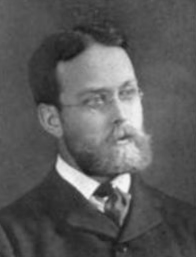
Lawrence Joseph Henderson
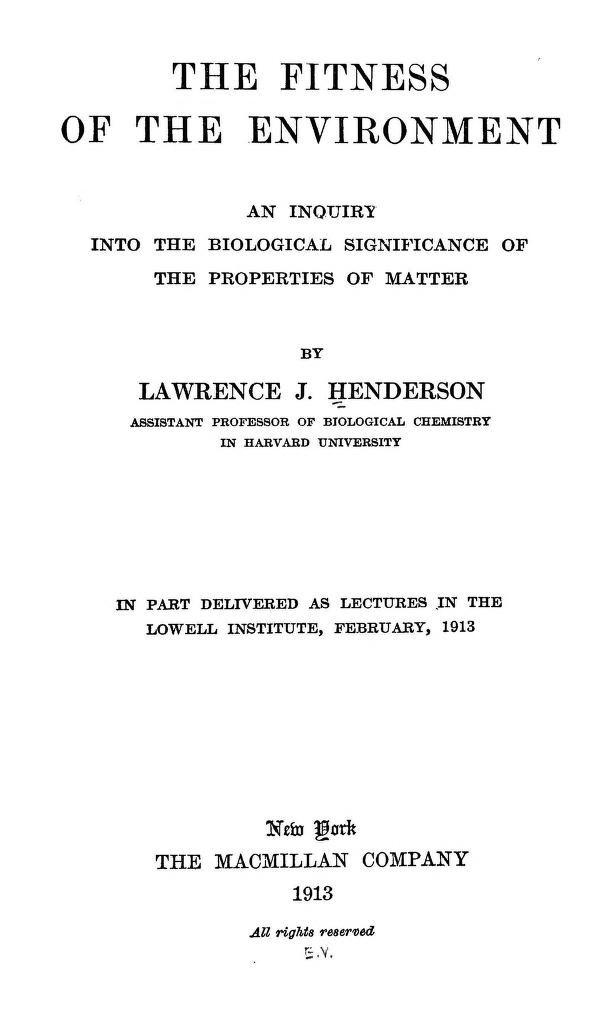
Henderson argued in The Fitness of the Environment (1913) that the physical and chemical properties of water, carbon dioxide and the common elements suit them to life. The book rests on a body of evidence, not on a single argument1. Later authors used its figures, cited it, or read it as a return to purpose in nature678.
- Born
- 3 June 1878
- Died
- 10 February 1942
- Country
- United States
- Field
- chemist, sociologist, biochemist
- In the library
- 1 work, named in 6 passages elsewhere
- Facts from
- Wikidata · Wikipedia · Open Library
The argument from fitness
Henderson wrote that the chapters of evidence, not the logical framing, were the true ground of the conclusion1. Henderson also noted that the idea of final causes had often led investigators to the right description of an organ, through its utility to the whole organism2. For water, Henderson counted three effects: it moderates the temperature of the earth, it allows regulation of the temperature of the organism, and it favours the meteorological cycle. Henderson called these true maxima, since no other substance compares with water3.
Acid, buffers and metabolism
Henderson treated the constant resistance of the organism to acid as a basic regulatory feature. Metabolism tends toward acid, because foodstuffs are mostly neutral while their end products are mostly acids such as carbonic, phosphoric and sulphuric4. Bayliss reported a finding by Henderson (1908) on the alkali needed to shift hydrogen ion concentration in various weak acids. Phosphate and carbonic acid required the largest quantities, with a large step down to the next in the series5.
Use and dispute by later authors
Lotka drew on Henderson's estimates of energy in the inorganic cycle. These included the Gulf Stream's transport of two hundred million tons of water per second7. Rádl read the book as a return to the pre-Darwinian idea of purpose in the universe, with an environment best fitted to life6. Loeb cited the book in a note while discussing whether the environment causes adaptive change in organisms, a view Loeb treated with caution8.
it is upon the general character of the evidence rather than upon an argument which only serves as a means to the end that I should wish to rest my case.
Henderson, L. J., 1913 · The Fitness of the Environment · open at passage 4The dogma of final .causes had led a thou- sand times to the truth by teaching the investigator that the true description of an organ or physiological process was to be found in its utility to the organism as a whole.
Henderson, L. J., 1913 · The Fitness of the Environment · open at passage 12it operates powerfully to, equalize and to moderate the temperature of the earth; secondly, it makes possible very effective regulation of the tem- perature of the living organism
Henderson, L. J., 1913 · The Fitness of the Environment · open at passage 154This tendency toward acidity of reaction and the accumulation of acid in the body is one of the inevitable characteristics of metabo- Usm
Henderson, L. J., 1913 · The Fitness of the Environment · open at passage 232A remarkable fact was noticed by Henderson (1908, p. 176) in comparing the relative amounts of alkali necessary to produce a given change in the H' ion concentration
Bayliss, W. M., 1915 · Principles of General Physiology · open at passage 898In a very able treatise Lawrence Henderson goes back definitely to the pre-Darwinian conception of the purpose- ful in the universe.
Rádl, E., 1930 · The History of Biological Theories · open at passage 948an estimate given by L. J. Henderson according to which the gulf stream alone conveys" two-hundred million tons of water per second through the straits of Yukatan.
Lotka, A. J., 1925 · Elements of Physical Biology · open at passage 7482 Henderson, L., The Fitness of tJie Environment. See also Michaelis, L., Die Wasserstoffionenconzentration. Berlin, 1914.
Loeb, J., 1916 · The Organism as a Whole, from a Physicochemical Viewpoint · open at passage 483
.png)