Current of injury
The current of injury, also called the injury current or demarcation current, flows between an injured point of living tissue and an uninjured one. Early physiologists used it as a baseline for reading excitation, because stimulation reduced it, a change called the negative variation.1 Later authors tied it to membrane permeability3 and to the currents that flow from wounds and amputations.8
- Earliest held
- 1852, Du Bois-Reymond, E. (ed. H.…
- Most discussed in
- Comparative Electro-Physiology: A…, 1907
- In the library
- 224 passages in 16 works
- Rewritten
- 2026-10-04
Early work on nerve
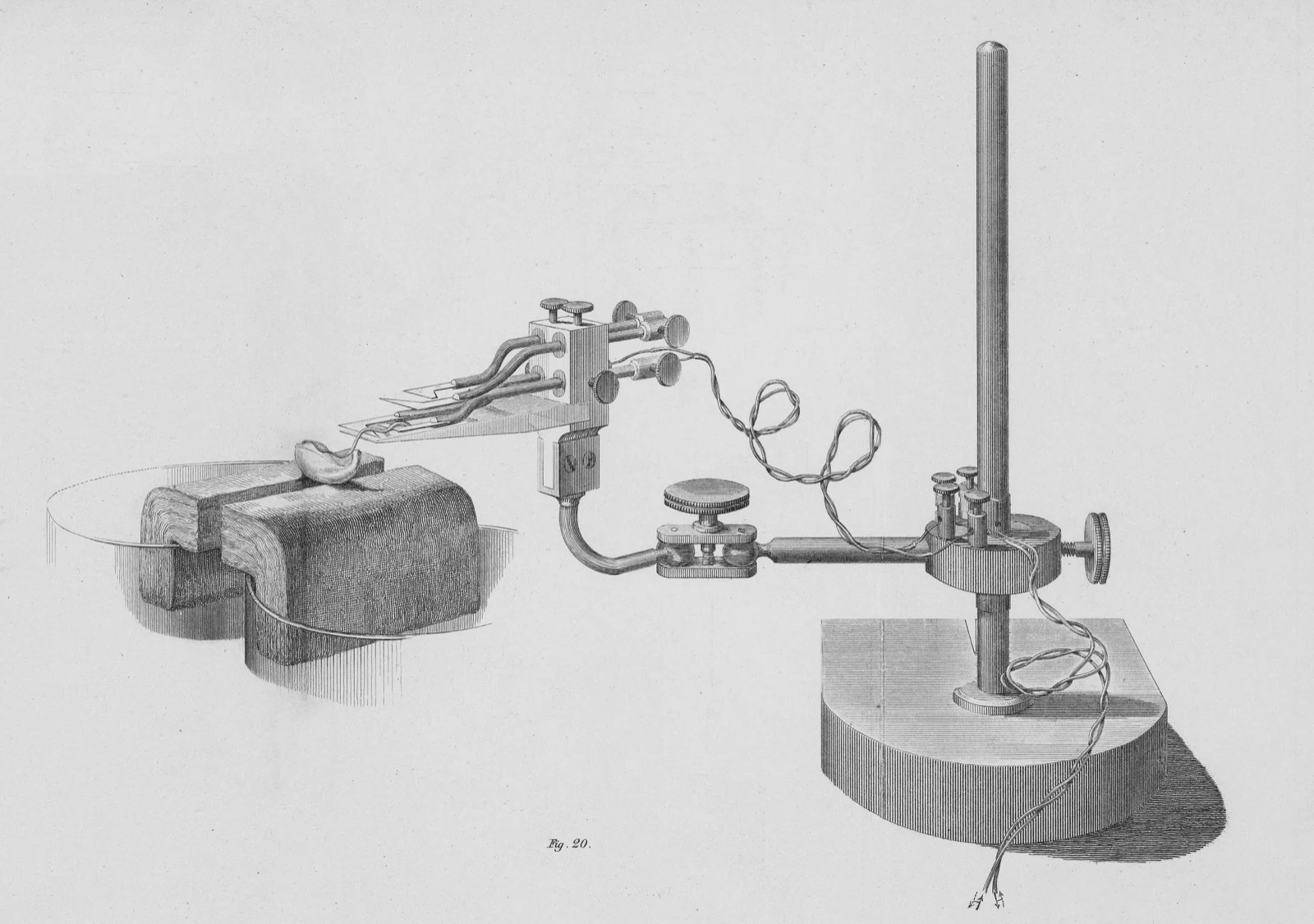

Bose (1902) treated the current of injury as the baseline against which excitation is read. He argued that stimulation reduces the existing difference of potential, so a nerve shows a negative variation. He described this as a current of action opposed to the current of injury, running from the more excited region to the less excited one.1 He also noted that some physiology textbooks had drawn wrong inferences by supposing the injured end to be zinc-like.1 Bose (1907) reported that the same excitatory reaction could give opposite signs. With slight injury the response was a negative variation. When the injured point was killed, the injury current reversed and the response was a positive variation.2
Membrane explanations
Bayliss (1915) gave a membrane account. He wrote that excitation is accompanied by increased permeability of the cell membrane.3 If the membrane is impermeable at rest to one ion only, it is polarised, and the current of rest is accounted for. Loss of that semipermeability in excitation then accounts for the negative variation.3 Lillie (1923) reported Hober's finding that potassium, rubidium and ammonium salts produce an injury current in muscle, while sodium and lithium salts leave the surface potential unchanged.4 Lillie put the maximum change during contraction near 0.05 volt, similar to the demarcation current. He added that some observers found larger action potentials, up to 0.08 volt.5
Injury as a method
Bose also used injury as an experimental tool. In The Nervous Mechanism of Plants (1926) he described abolishing the excitability of one contact by local injury, so that the response at the other contact is not opposed. This produces a current of injury, and the response appears as a negative variation of it.6 The injured tissue may recover, which shrinks the response, so a fresh injury must be made.6 In The Motor Mechanism of Plants (1928) he described the animal method in the same terms. The injured point is negative, and the response disappears as the current of injury subsides.7
Wound currents today
Recent reviews place the current of injury within work on regeneration. Tyler (2017) reported that wounding human skin generates an injury current, typically 1 to 10 μA/cm2, citing Nuccitelli. Amputated newt limbs gave 10 to 100 μA/cm2, and newly amputated human fingertips gave 22 μA/cm2.8 Tyler noted the suggestion that regenerating and non-regenerating systems differ in their bioelectric characteristics.8 O'Hara-Wright and colleagues (2022) described the injury potential as a difference between intact epithelium and the wound. Current leaks from the wound edge as the path of least resistance and creates an electric field.9
and acted in an opposite direction to the current of injury (fig. 2,4). The action current in the nerve is from the relatively more excited to the relatively less excited.
Bose, J. C., 1902 · Response in the Living and Non-Living · open at passage 30It will thus be seen that an identical excitatory reaction of the living tissue appears to give rise to directly opposite
Bose, J. C., 1907 · Comparative Electro-Physiology: A Physico-Physiological Study · open at passage 479There is evidence that the state of excitation is accompanied by increased permeability of the cell membrane.
Bayliss, W. M., 1915 · Principles of General Physiology · open at passage 1884produce an injury-current or local negativity. Absence of penetration is indicated by failure to change the external potential of the muscle
Lillie, R. S., 1923 · Protoplasmic Action and Nervous Action · open at passage 279The maximum range of variation during contraction does not usually appear to exceed 0.05 volt, a potential-difference similar to that of the demarcation-current.
Lillie, R. S., 1923 · Protoplasmic Action and Nervous Action · open at passage 537This method introduces several complications: a current of injury is produced, and the response at A is then observed as a negative variation of the current of injury.
Bose, J. C., 1926 · The Nervous Mechanism of Plants · open at passage 232Then the current of injury gradually subsides, with the result of disappearance of response by negative variation.
Bose, J. C., 1928 · The Motor Mechanism of Plants · open at passage 374Immediately upon wounding human skin, an endogenous ionic flux generates the so-called injury current, typically between 1 and 10 μA/cm2
Tyler SEB, 2017 · Nature's Electric Potential: A Systematic Review of the Role of Bioelectricity… · open at passage 19Known as the injury potential, or demarcation current, a difference in electrical potential is created between intact epithelium and the site of a wound
O'Hara-Wright M, Mobini S, Gonzalez-Cordero A, 2022 · Bioelectric Potential in Next-Generation Organoids: Electrical Stimulation to… · open at passage 19
| 1907 | Comparative Electro-Physiology: A Physico-Physiological Study · Bose, J. C. | 112 |
| 1902 | Response in the Living and Non-Living · Bose, J. C. | 37 |
| 1852 | On Animal Electricity: Being an Abstract of the Discoveries of Emil du… · Du Bois-Reymond, E. (ed. H. Bence Jones) | 17 |
| 1906 | Plant Response as a Means of Physiological Investigation · Bose, J. C. | 13 |
| 1915 | Principles of General Physiology · Bayliss, W. M. | 13 |
| 1923 | Protoplasmic Action and Nervous Action · Lillie, R. S. | 11 |
| 1918 | Life Movements in Plants · Bose, J. C. | 9 |
| 1928 | The Motor Mechanism of Plants · Bose, J. C. | 3 |
| 1926 | The Nervous Mechanism of Plants · Bose, J. C. | 2 |
| 2017 | Nature's Electric Potential: A Systematic Review of the Role of Bioelectricity… · Tyler SEB | 1 |