Galvanotaxis
Galvanotaxis, also called electrotaxis or galvanotropism, is the orientation and movement of cells or animals in an electric current. Physiologists first studied it in whole animals and single-celled organisms. Recent work applies it to migrating cells in wounds and tumours.
- Earliest held
- 1875, Darwin, C.
- Most discussed in
- General Physiology: An Outline of the Science…, 1899
- In the library
- 190 passages in 28 works
- Rewritten
- 2026-11-10
Early observations
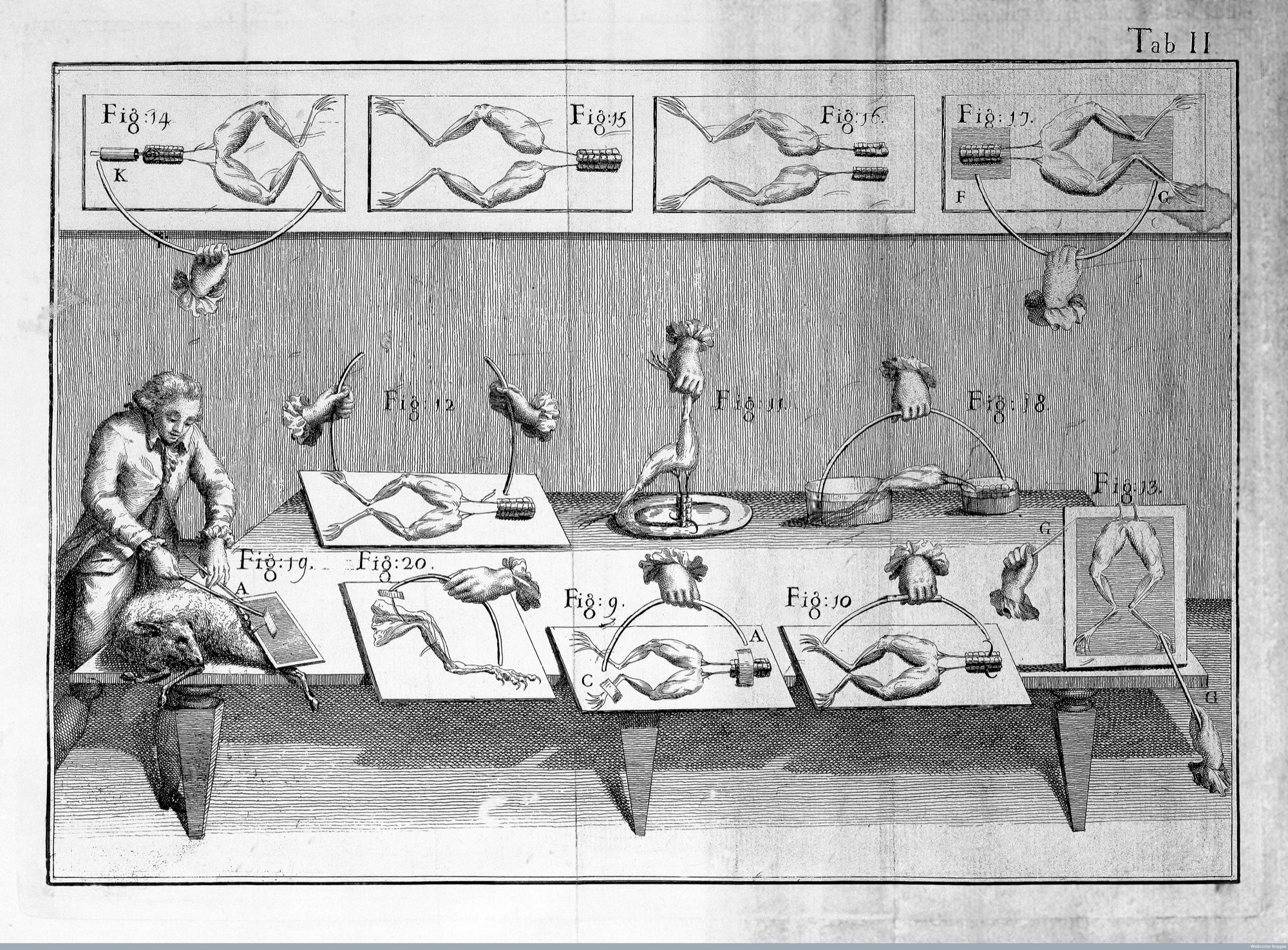

Verworn (1899) reported Kühne's 1864 observation that Actinosphaerium obeyed a very different law of excitation. The observation stayed isolated for more than two decades and was recalled only after other effects of the galvanic current were found.1 Loeb (1906) said the reactions were first found in vertebrates. Purkinje reported sensations of motion and dizziness when current crossed the human brain.3 Verworn also noted that in ciliates the intensity of the current decides between forward swimming, backward swimming and standstill.2
Loeb's physical account
Loeb (1912) treated galvanotropism as a counterpart of heliotropism. In his account the current lines play the part that light rays play for light, and ions collect where the current enters the cells.4 In 1918 he called it a form of forced motion, produced by the current in place of an injury to the brain. He reduced the effects to changes in the tension of associated muscles or contractile elements, which ease movement toward one pole and hinder it toward the other.5
Migrating cells in fields
Later authors use the word electrotaxis for cells in culture. Funk (2015) summarised that bioelectric factors override most chemical gradients. Many cell types migrate to the cathode at about 0.1–10 V/cm, while few, such as corneal endothelial cells, go to the anode.6 Sun (2017) described the work of Djamgoz and colleagues, in which strongly metastatic rat prostate cancer cells moved to the cathode and weakly metastatic cells did not respond.7 Zhu et al., as reviewed by Sheth and Esfandiari (2022), reported that metastatic sublines of 4T1 cells differed in their thresholds, with some moving toward the anode at 100 mV/mm or higher.8
Galvanotaxis as a test
De la Fuente and colleagues (2019) used galvanotaxis as the stimulus in experiments on conditioned behaviour in amoebae. After an induction process, they exposed cells to the field, rested them in medium without stimulus, and exposed them again with the polarity inverted. The tests ran for 68 min in one scenario and 95 min in another.9 In this work the electric field serves as a controlled test of cell behaviour.
In the year 1864 Kiihne made the peculiar observation that Actinosphcerium EichJiornii (Fig. 198) obeys a very different law of excitation.
Verworn, M., 1899 · General Physiology: An Outline of the Science of Life · open at passage 1049That all these three possibilities are realised, is shown most beautifully by galvanotaxis, in which, according to the intensity of the galvanic current, swimming forward or backward, or standstill, can be obtained.
Verworn, M., 1899 · General Physiology: An Outline of the Science of Life · open at passage 1272The galvanotropic reactions were first discovered in vertebrates. Purkinje noticed that if a galvanic current is sent through the brain of a human being, sensations of motion and dizziness are produced.
Loeb, J., 1906 · The Dynamics of Living Matter · open at passage 390In galvanotropism the current lines or the current curves play the same role as the light rays in heliotropism.
Loeb, J., 1912 · The Mechanistic Conception of Life · open at passage 91Galvanotropism is, therefore, a form of forced motions produced by the galvanic current instead of by injury to the brain.
Loeb, J., 1918 · Forced Movements, Tropisms, and Animal Conduct · open at passage 68Interestingly, bioelectric factors override most chemical gradients. In vitro experiments revealed that many cell types prefer to migrate to the cathode when the externally applied field strengths is around 0.1–10 V/cm (electrotaxis)
Funk RH, 2015 · Endogenous electric fields as guiding cue for cell migration · open at passage 21rat prostate cancer MAT-LyLu cells (which are highly metastatic) exhibited strong electrotaxis by moving to the cathode, and rat prostate cancer AT-2 cells (which are weakly metastatic) showed no electrotactic behavior.
Sun YS, 2017 · Studying Electrotaxis in Microfluidic Devices · open at passage 6after the induction process, the cells were exposed to 5 min without stimulus, 30 min on galvanotaxis, 3 min without stimulus and 30 min on galvanotaxis with inverted polarity
De la Fuente IM, Bringas C, Malaina I, Fedetz M…, 2019 · Evidence of conditioned behavior in amoebae · open at passage 17parental 4T1 and lung metastatic cell lines were found to respond to EFs as low as 50 mV/mm, while other metastatic sublines showed an anodal migration in a field of 100 mV/mm or higher.
Sheth M, Esfandiari L, 2022 · Bioelectric Dysregulation in Cancer Initiation, Promotion, and Progression · open at passage 25
| 1899 | General Physiology: An Outline of the Science of Life · Verworn, M. | 49 |
| 1918 | Forced Movements, Tropisms, and Animal Conduct · Loeb, J. | 33 |
| 1906 | The Dynamics of Living Matter · Loeb, J. | 16 |
| 2017 | Studying Electrotaxis in Microfluidic Devices · Sun YS | 15 |
| 2019 | Evidence of conditioned behavior in amoebae · De la Fuente IM, Bringas C, Malaina I… | 14 |
| 1906 | Plant Response as a Means of Physiological Investigation · Bose, J. C. | 8 |
| 1900 | Comparative Physiology of the Brain and Comparative Psychology · Loeb, J. | 7 |
| 1924 | Physiological Foundations of Behavior · Child, C. M. | 7 |
| 1912 | The Mechanistic Conception of Life · Loeb, J. | 6 |
| 1916 | The Organism as a Whole, from a Physicochemical Viewpoint · Loeb, J. | 5 |