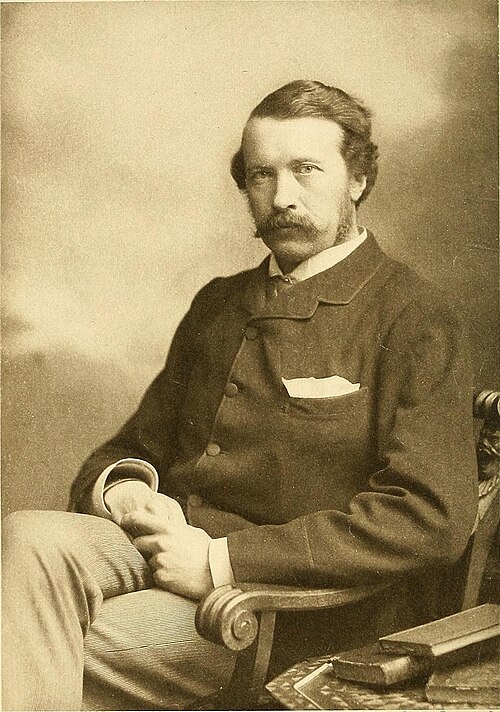
George John Romanes
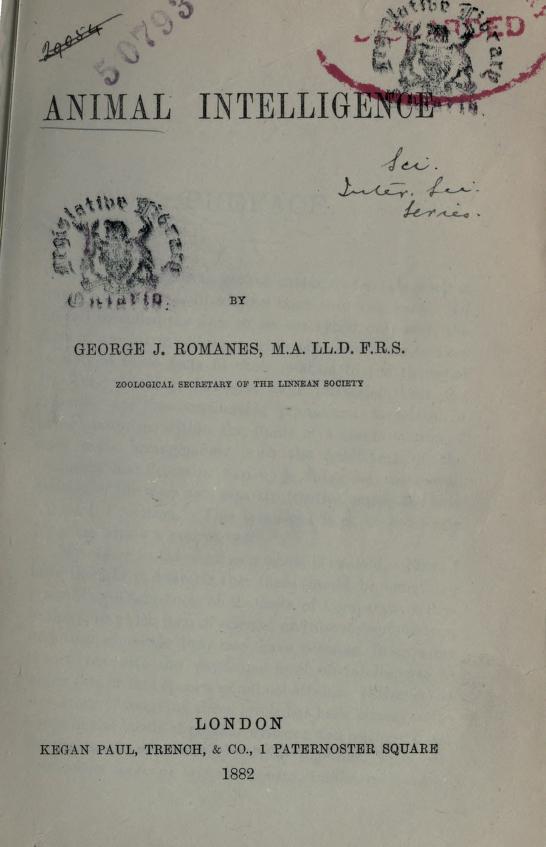
Romanes wrote Animal Intelligence, defining intelligence as the intentional adaptation of means to ends1. Later authors credit them with the test that intelligence is shown when an animal profits from its own experience2. They also experimented on jellyfish nerve and muscle34, and on a dog's scent tracking5.
- Born
- 20 May 1848
- Died
- 23 May 1894
- Country
- United Kingdom of Great Britain and Ireland
- Field
- psychologist, poet, zoologist
- In the library
- 1 work, named in 12 passages elsewhere
- Facts from
- Wikidata · Wikipedia · Open Library
Defining intelligence
Trewavas reports that Romanes defined intelligence as the intentional adaptability of means to ends1. In Trewavas's account, Romanes told Darwin that intelligence can only be safely inferred when an individual profits from its own experience. Darwin answered with earthworms dragging leaves into burrows, trying one way after another until they succeed2. Trewavas reads this as trial and error, and judges that Romanes grasped biological intelligence better than Darwin did.
Experiments on medusae
Jennings called the bell of the medusa a classical object through Romanes's work. Romanes cut the margin of the bell, which holds most of the nervous system, from the centre. Jennings also quotes Romanes on the manubrium, which dodged about the bell as if seeking the offending body4. Jennings examines these words as evidence in his own argument.
Use and criticism
Washburn calls Romanes's tests of a setter tracking a human trail well known5. Binet cites Romanes's view that the power of choice marks psychical faculties6. Binet also objects that Romanes's chart of the intellect, which has memory begin with the echinoderms, is arbitrary7. Rádl records that Romanes, with Spencer, upheld the inheritance of acquired characters, as a follower of Darwin8.
Romanes included a definition of intelligence (Romanes 1883. p17) of “Intentional adaptability of means to ends”.
Trewavas A, 2025 · Plant intelligence dux: a comprehensive rebuttal of Kingsland and Taiz · open at passage 35Romanes pointed out that intelligence can only be safely inferred when we see that an individual profits from its own experience.
Trewavas A, 2025 · Plant intelligence dux: a comprehensive rebuttal of Kingsland and Taiz · open at passage 34Romanes found that in the Hydromedusse the margin continues to beat rhythmically, while the centre usually ceases its spontaneous movement.
Jennings, H. S., 1906 · Behavior of the Lower Organisms · open at passage 651the manubrium actively dodges about from one part of the bell to another, applying its extremity now to this place and now to that one, as if seeking in vain for the offending body.
Jennings, H. S., 1906 · Behavior of the Lower Organisms · open at passage 570The experiments of Romanes on the power of a favorite setter to track his scent are well known.
Washburn, M. F., 1908 · The Animal Mind: A Textbook of Comparative Psychology · open at passage 193As Romanes has indeed observed, the power of choice may be regarded as the criterion of psychical faculties.
Binet, A., 1888 · The Psychic Life of Micro-organisms: A Study in Experimental Psychology · open at passage 248Romanes has minutely particularized on a large chart the development of the intellectual powers, in quite an arbitrary manner.
Binet, A., 1888 · The Psychic Life of Micro-organisms: A Study in Experimental Psychology · open at passage 4Herbert Spencer and Romanes strongly upheld the doctrine of the inheri- tance of acquired characters.
Rádl, E., 1930 · The History of Biological Theories · open at passage 623